Stay DDQ Ready with Structured CRM and Checklists
Move DDQ preparation from last-minute document collection to a maintained readiness process.
Organize evidence before it is requested
A due-diligence response is easier to prepare when responsibilities, policy versions and supporting operational records are maintained throughout the year. Technology supports the process; qualified advisers should review final requirements and representations.
What DDQ Readiness for MFDs covers
A focused set of modules and workflows configured around the way your practice operates.
DDQ section, document and evidence index
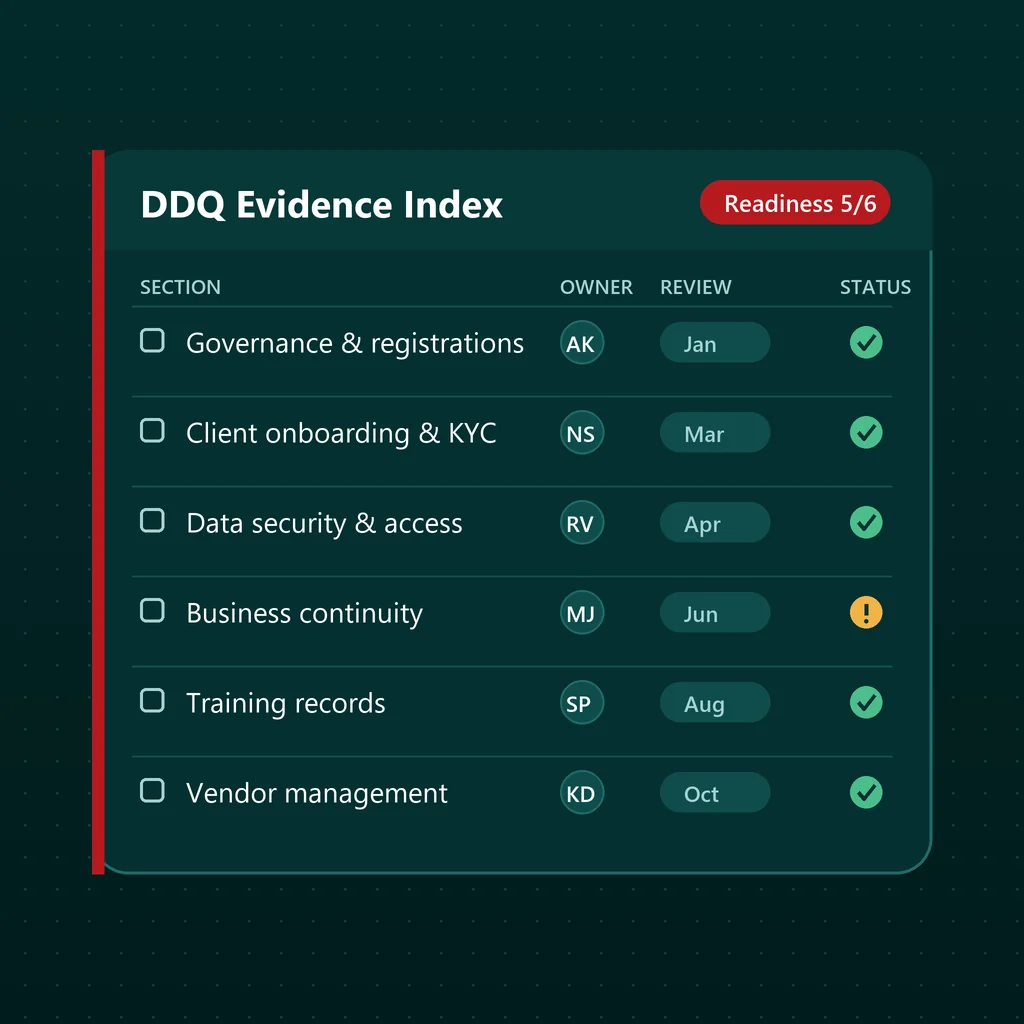
A structured index maps each questionnaire section to the documents and records that support it, where each item is stored and when it was last updated. Responses can then be assembled from maintained evidence instead of being searched for under deadline pressure.
Named owners, reviewers and renewal dates
Every document and record has a named owner who maintains it and a reviewer who checks it. Renewal and review dates, such as ARN and EUIN validity or agreement expiry, generate tasks in advance so items do not lapse unnoticed between questionnaires.
Policy version and approval tracking
Policies are stored with version numbers, a summary of changes, the approver's name and the approval date. When a questionnaire asks for a current policy, the team can show which version applies and when it was approved, rather than guessing from file names.
Training, vendor and business-continuity records
Staff training sessions, vendor and service-provider details, data-handling arrangements and business-continuity tests are recorded as they happen. These operational records are often the hardest to recreate later, so logging them during the year matters most.
Open observation and remediation tracker
Findings from internal reviews, external audits or earlier questionnaires are logged as observations with an owner, agreed action and target date. The tracker shows what is open, what has closed and which evidence supports each closure.
Readiness dashboards and overdue alerts
Dashboards show which sections have current evidence, which items are due for review and which are overdue. Owners and management receive alerts before dates pass, so readiness becomes a status you can check at any time rather than a yearly project.
What DDQ readiness means for an MFD practice
A due diligence questionnaire asks a distributor to describe how the business is run and to support those answers with evidence. Readiness means that evidence is organized, owned and current before anyone asks for it.
This page describes process and record-keeping only. The areas a questionnaire covers and what is expected in each can change, so requirements should always be confirmed against the current questionnaire and current AMFI and SEBI guidance, and reviewed by qualified compliance or legal professionals.
Why DDQ preparation turns into a last-minute scramble
In most practices the evidence exists somewhere. The difficulty is that nobody owns it, it is spread across personal drives and email, and the activities that should have been recorded during the year were never written down.
- Policies exist in several versions with no record of which was approved
- Training happened but attendance was never recorded
- Vendor and service-provider details are not kept in one place
- Complaint and service handling is done well but not logged
- Previous responses were not saved alongside their supporting evidence
- The one person who knew where everything was has left
Building an evidence index and responsibility matrix
Start from the questionnaire you have received or expect to receive. List each section and, under it, the specific items of evidence that would support a response. For each item, record the evidence type, where it is stored, the owner, the reviewer, the review frequency and the date last updated.
Where evidence originates in daily operations, link it to the CRM records that produce it. Service request logs, complaint records, KYC and nominee status tracking and client communication history can all serve as supporting records when they are kept consistently. Keep untouched originals of submitted responses as a reusable base for the next cycle.
How the CRM keeps records current through the year
Readiness is maintained through small, regular actions rather than an annual effort. The CRM assigns those actions and records when they are done, with an audit trail showing who changed what and when.
- Policy review tasks created ahead of each review date
- Training sessions logged with date, topic and attendees
- Vendor list reviewed on a set cycle with contract and renewal dates
- Business-continuity tests recorded with observations and follow-up actions
- A periodic self-check of the evidence index, with gaps assigned to owners
Handling sensitive records and access
A readiness system often holds sensitive information, including client documents, agreements and internal findings. Restrict access by role, limit who can export or download, and avoid storing copies of client documents that the workflow does not need.
Retention periods and data-handling obligations are regulatory and legal questions. Decide them with qualified professionals, then configure the system to support the agreed approach rather than setting rules by assumption.
What technology can and cannot do for DDQ readiness
Technology can organize evidence, assign owners, send reminders, show status and preserve history. It cannot interpret regulation, judge whether a policy is adequate, sign representations on behalf of the business or guarantee any outcome.
Aina Tech provides the structure and tooling for this process. Final responses and the underlying framework should be reviewed by management and by qualified professionals before anything is submitted.
From current process to working system
We start with how work happens today, then build and improve in controlled phases.
Step 1
Assess expected DDQ areas and current gaps
Step 2
Create the evidence index and responsibility matrix
Step 3
Configure reviews, reminders and remediation tracking
Step 4
Complete management and professional compliance review
Questions about DDQ Readiness for MFDs
Does this guarantee compliance?+
No. Aina Tech provides technology and process support, not legal or regulatory advice. Qualified professionals should review the final framework.
What documents can be tracked?+
Business, policy, training, vendor, security, continuity and operational evidence can be indexed according to your reviewed requirements.
Can renewal and review reminders be automated?+
Yes. Owners can receive advance tasks and overdue escalations based on document or policy review dates.
Can previous DDQ responses be reused?+
They make a useful starting point, especially when each answer is linked to its supporting evidence. Every response should still be checked against the current questionnaire and current guidance, and reviewed before submission.
Who should own DDQ readiness in a small MFD practice?+
The principal usually remains accountable, an assistant or operations person maintains the evidence index and reminders, and an external compliance professional reviews the framework and final responses. Writing these roles down is part of readiness.
Is a spreadsheet enough to track DDQ evidence?+
For a very small practice it can work as a starting point. Spreadsheets struggle with reminders, ownership, version history and audit trails, which is usually where readiness breaks down as the practice grows.
Ready to explore DDQ Readiness for MFDs for your practice?
Start with a practical review of your current data, workflows, team roles and growth priorities.