
DDQ Checklist for Mutual Fund Distributors
A working checklist for organizing governance, client servicing, data security, operations and evidence before a due-diligence review.
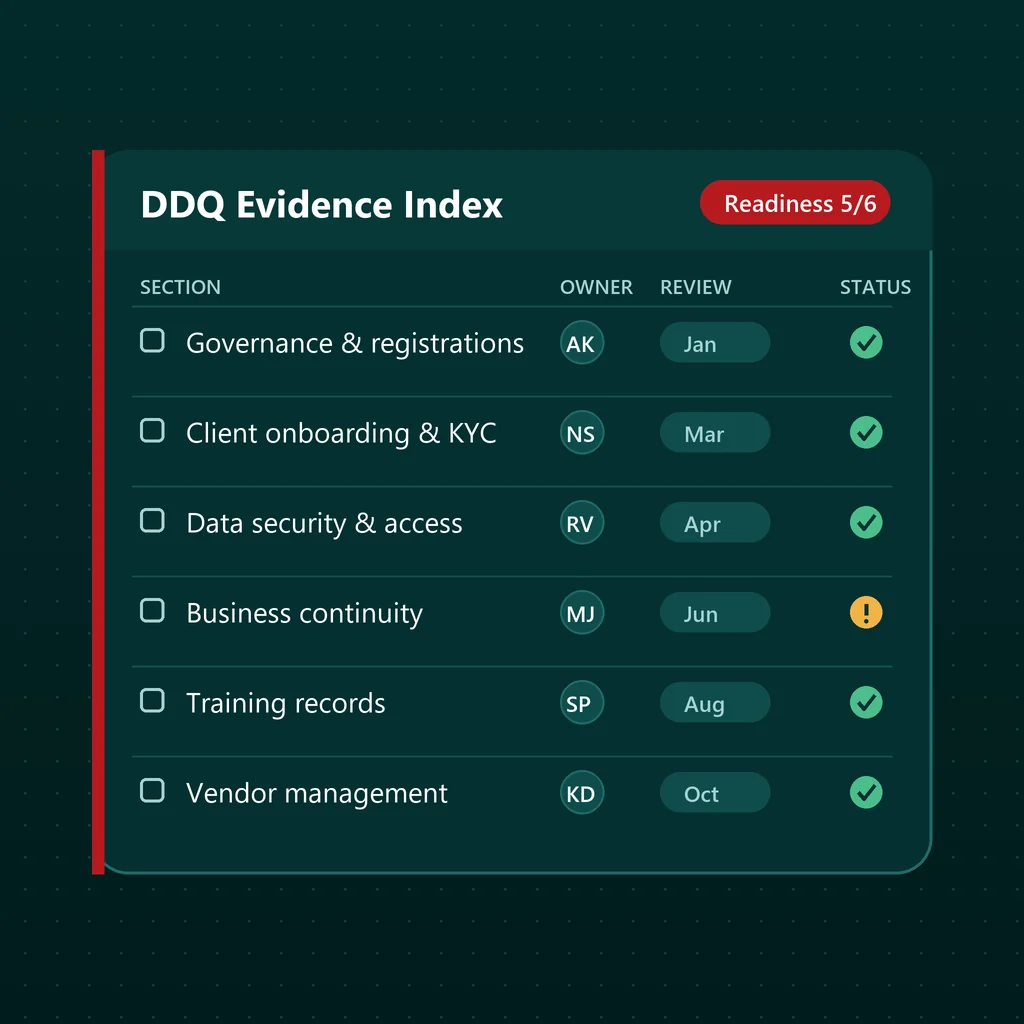
A due-diligence questionnaire is easier to handle when operational evidence is organized before it is requested. The objective is not merely to answer questions, but to demonstrate that policies are reflected in repeatable day-to-day processes.
How to use this DDQ checklist for mutual fund distributors
Every item below follows the same pattern: a policy or statement, the process that puts it into practice, the record that proves the process happened, and the person who owns it. A DDQ answer is only as strong as the weakest of those four.
Questionnaires differ between the AMCs, platforms and institutions that send them, so treat this as a working list of areas and evidence types, not a fixed template. Confirm current requirements against AMFI and SEBI guidance and the reviewing institution's own questionnaire.
For each area, mark every evidence item as available, missing, outdated or awaiting approval. That status column is what turns a checklist into a readiness tracker.
Give every evidence item a short reference code and record where it is stored, whether that is a shared folder, the CRM or a vendor portal. When a reviewer asks a follow-up question, you can then point to the exact record instead of searching inboxes.
Governance and registration: what evidence to keep
Reviewers usually begin by confirming who the business is, who is responsible for what and whether registrations are current. Keep these documents in one place with their validity dates visible.
- ARN certificate and records of renewal for the firm
- EUIN details for each employee who interacts with investors, with validity dates
- Constitution documents for the entity, such as partnership deed or incorporation papers
- Organization chart with reporting lines
- Responsibility matrix naming owners for compliance, operations, data and complaints
- Minutes or notes of periodic management reviews of these areas
Client onboarding and KYC: evidence reviewers look for
This area tests whether onboarding happens the same way every time. A written procedure matters, but so does a trail showing that each step was actually completed for real clients.
- Written onboarding procedure and checklist
- Records of KYC status verification for each investor
- Risk profiling or suitability documentation, where your service model requires it
- Nominee registration or opt-out records
- FATCA and other declarations collected at onboarding
- Communication consent and preferred contact channel
- A sample of completed client files that match the procedure
Transactions and client servicing: records that prove the process
Reviewers often ask how you receive client instructions, confirm them and handle problems. The evidence here is operational: logs, registers and timestamps rather than policy documents.
- Procedure for receiving and confirming transaction instructions
- Trail of client instructions for purchases, redemptions, SIP, STP and SWP requests
- Service request register with category, owner, dates and closure
- Turnaround standards and reports showing actual performance
- Process and records for SIP rejections, failed mandates and other exceptions
- Records of nominee, bank and contact detail change requests
Data security and access control: evidence checklist
MFD businesses hold PAN, bank details and contact information, so data handling gets close attention. The strongest answers point to specific settings and logs rather than general statements about being careful.
- Information security or data handling policy with a review date
- List of systems holding client data and who has access to each
- Periodic access reviews, including removal of access when staff leave
- Password, multi-factor authentication and device usage rules
- Backup arrangements and evidence of at least one tested restoration
- Incident log, even if it records that no incidents occurred
- Rules for sharing client files internally and with third parties
Vendors, continuity and communications: what to document
Most MFDs rely on several outside providers for back office, CRM, messaging, email and storage. Reviewers want to know you understand who holds your data and what happens if a provider or key person becomes unavailable.
- Vendor register listing each provider, the data it holds and the internal owner
- Contracts or terms covering data handling for key vendors
- Business continuity plan covering systems, people and office access
- Communication policy for WhatsApp, email and phone use with clients
- Approval records for marketing material and client communications
Complaints, training and policy review evidence
This final area shows whether the business learns and keeps its documents current. An old policy with no review history can weaken otherwise good answers elsewhere.
- Complaint register with dates, owners, responses and closure
- Escalation path for complaints that are not resolved at first contact
- Training calendar and attendance records for staff
- Records of certification and continuing education where applicable
- Policy index showing each document's owner, version and last review date
Core checklist
Business registrations, ownership and responsibility matrix
Client onboarding, risk profiling and service procedures
Data access, password, backup and incident-response controls
Vendor list, software access and business-continuity arrangements
Complaint, escalation and interaction-record processes
Policy review dates, training records and supporting evidence
A practical action plan
- 1
Create a DDQ evidence folder with a named owner for every section.
- 2
Link each written policy to the operational record that proves execution.
- 3
Track missing, expired and awaiting-approval documents centrally.
- 4
Have legal and compliance professionals review the final submission.
Frequently asked questions
What is a DDQ for a mutual fund distributor?+
A due-diligence questionnaire is a structured set of questions an AMC, platform or institutional partner may use to understand how a distributor operates. It typically covers governance, onboarding, servicing, data security, vendors and complaints. The exact questions vary by the institution sending it.
What is the difference between a policy and evidence in a DDQ?+
A policy says what the business intends to do. Evidence shows that it actually happens, for example a service request log, an access review record or a training attendance sheet. Reviewers generally place more weight on evidence that matches the policy.
How long should an MFD keep DDQ evidence?+
Retention periods depend on the type of record and on applicable regulatory and contractual requirements. Confirm them with current AMFI and SEBI guidance and a qualified professional. Operationally, keep each submitted DDQ with its evidence set so you can answer follow-up questions later.
Can CRM records be used as DDQ evidence?+
CRM records such as service request histories, task logs and access settings can support DDQ answers when they are complete and consistent. A well-configured system like Aina CRM makes these records easier to produce. The records still need to reflect real practice and be reviewed before submission.
A final note
This checklist is for operational preparation and is not legal or regulatory advice. Requirements should be validated for your business and the reviewing institution.
See how Aina Tech sets this up in practice: DDQ Readiness and Compliance System for MFDs.
This article provides general operational and technology information. It is not investment, legal, tax or regulatory advice.