How to Prepare Your MFD Business for DDQ Audit
Turn DDQ preparation from a last-minute document hunt into a controlled evidence, ownership and review process.
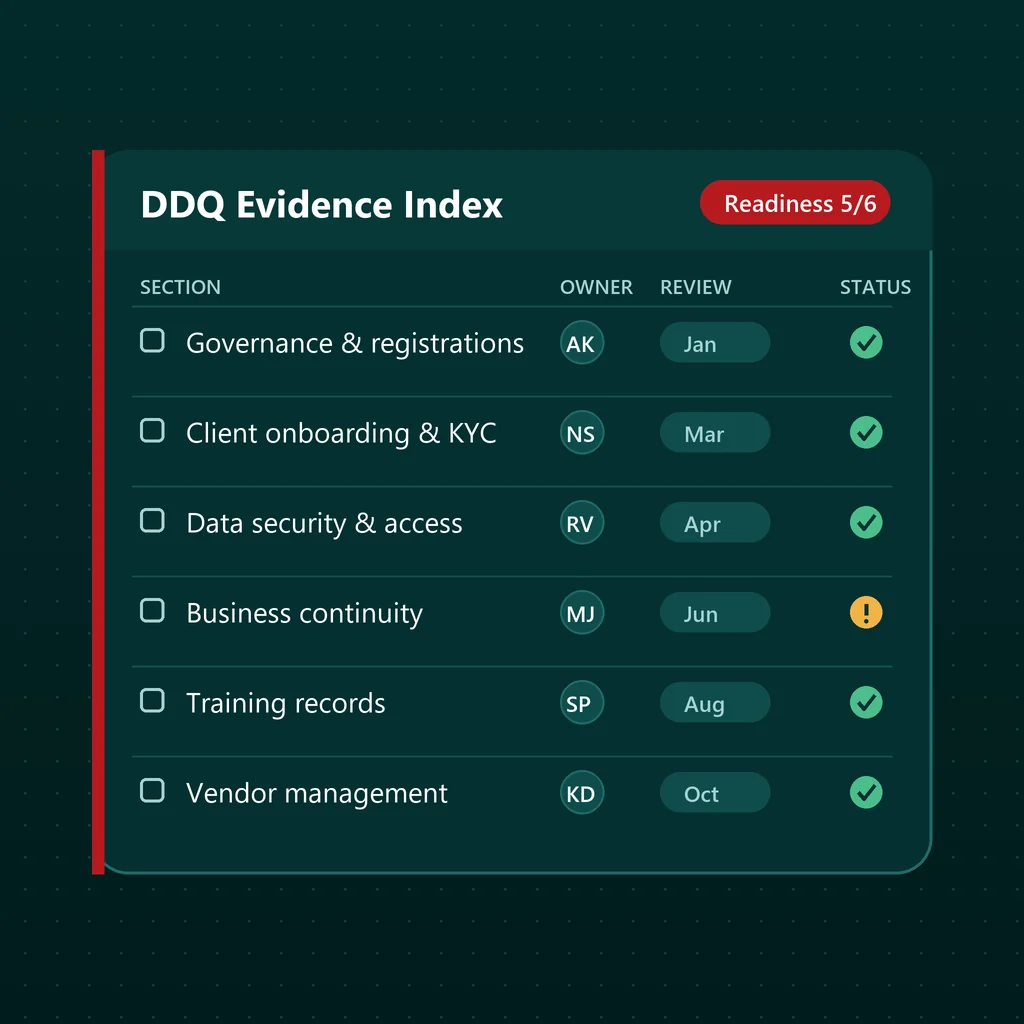
DDQ readiness is an operating discipline. Firms struggle when documents are scattered, policy owners are unclear and written answers do not match the way work is actually performed.
Who should own DDQ audit preparation in an MFD firm?
Treat DDQ preparation as a small internal project with named roles. When everyone is partly responsible, documents arrive late, answers contradict each other and the owner ends up rewriting everything the night before submission.
In a small practice one person may hold two roles, and that is fine. What matters is that each role is named and that the approver is someone with authority to make decisions about gaps.
- Coordinator: runs the plan, tracks status and chases deadlines
- Area owners: responsible for evidence and draft answers in their area, such as onboarding, operations or data
- Approver: a partner or director who signs off on the final answers and any disclosed gaps
- External reviewer: a compliance or legal professional who checks the submission before it goes out
Phase 1: scoping and gap assessment
Start by getting the actual questionnaire, or the closest previous version, and breaking it into areas. Assign each question to an area owner and note what evidence the answer will need.
Each owner then rates their questions honestly: fully supported, partly supported or not supported. A partly supported answer usually means a process exists but is not written down, or is written down but not consistently followed.
The output of this phase is a gap register: one line per gap, with a description, an owner, a proposed fix and a target date. That register drives everything that follows.
Phase 2: closing gaps between policy and practice
Every gap has two possible fixes. Either the policy is rewritten to describe what the team really does, or the practice is changed to match the policy. The approver should make that call, not the person drafting the answer.
Record each decision in the gap register with the reason. If a practice is being changed, update the CRM configuration, checklist or template at the same time, so the new process leaves a record from day one.
Resist the urge to write policies that sound impressive but describe work nobody performs. A modest policy that is followed is far easier to defend than an ambitious one with no evidence behind it.
Phase 3: testing sample client files before submission
Before relying on your answers, test them against real records. Pick a sample of client files that covers different RMs, new and long-standing clients, families and individuals, and clients with recent service requests.
For each file, walk through the onboarding checklist, service history and communication records as a reviewer would. Note anything missing, inconsistent or hard to find.
- Is every onboarding step recorded with a date and owner?
- Do service requests show receipt, action and closure?
- Are contact detail and nominee changes supported by a client request?
- Can the file be retrieved quickly by someone other than the RM?
- Do the records match what the draft DDQ answer claims?
Phase 4: drafting answers and management review
Write answers that are specific, current and supported. Describe what the business does today, name the system or record where evidence sits, and give each answer an evidence reference that points to your index.
Where a gap remains open, say so plainly and describe the remediation plan and owner. Overstating readiness creates a larger problem if the reviewer asks for proof.
The approver should then review material answers and any disclosed gaps in a single session, with the coordinator recording changes. After that, the external reviewer checks the final draft before submission.
How to keep your MFD business DDQ-ready after submission
The effort is wasted if the evidence set goes stale. File the submitted response, the evidence index and the gap register together as one version, so the next questionnaire starts from a known baseline.
Then set a light maintenance rhythm. Evidence that expires, such as registration validity, access reviews and policy review dates, should appear on a calendar with an owner. Many firms use CRM tasks or recurring reminders for this.
- Quarterly check by each area owner that their evidence is current
- Remediation items tracked to closure with dates
- A log of reviewer follow-up questions and the answers given
- Annual refresh of policies, the responsibility matrix and the vendor register
Common mistakes in DDQ preparation
Most problems in DDQ preparation are planning problems rather than knowledge problems. These are the ones that show up most often.
- Starting when the questionnaire arrives instead of maintaining evidence year-round
- One person drafting every answer without input from area owners
- Copying answers from another firm or a template without checking practice
- Evidence stored in personal email or phones instead of a shared index
- No record of what was submitted, making the next DDQ start from zero
Core checklist
Assign one coordinator and a responsible owner for each DDQ area
Maintain a version-controlled document and evidence index
Resolve differences between policy wording and current practice
Test sample client files and service records before submission
Record open observations, remediation owners and target dates
A practical action plan
- 1
Run an internal gap assessment against the expected questionnaire.
- 2
Collect evidence from CRM, ticketing, email, training and vendor records.
- 3
Conduct a management review of material gaps and representations.
- 4
Store the submitted response and its evidence set for future updates.
Frequently asked questions
How early should an MFD start preparing for a DDQ?+
Ideally, readiness is maintained continuously so a new questionnaire only needs updating. If you are starting fresh, begin with the gap assessment as soon as you expect a DDQ, because closing gaps and testing files takes longer than drafting answers.
Can DDQ preparation be outsourced?+
Parts of it can. External support can help organize evidence, build trackers, configure systems and review drafts. Management still has to own the answers, decide how gaps are handled and confirm that the responses reflect how the business actually works.
What if we find a gap we cannot fix before the DDQ deadline?+
Disclose it accurately with a remediation plan, an owner and a target date, and get the wording reviewed by a qualified professional. Reviewers generally respond better to an honest, managed gap than to an answer that later proves unsupported.
How does a CRM help with DDQ audit preparation?+
A CRM can hold service logs, task histories, onboarding checklists and access settings in one place, which makes evidence easier to find and test. Aina Tech configures these records as part of DDQ readiness support. The CRM supports the process but does not replace professional compliance review.
A final note
A CRM can improve traceability and ownership, but it does not replace professional compliance review or management accountability.
See how Aina Tech sets this up in practice: DDQ Readiness and Compliance System for MFDs.
This article provides general operational and technology information. It is not investment, legal, tax or regulatory advice.